
· Camille Ferrand
Vertical space for indoor cats: a home is measured in height
A studio organized upward gives a cat more than a two-bedroom where everything happens at floor level. It is a question of usable volume, not square footage.
The vertical territory
For a cat, the value of a place rises with its height. An elevated post lets it watch, keep out of the way, and sleep undisturbed. That is why a cat climbs onto the refrigerator or the wardrobe: it is looking for the highest available point.
In a home where nothing has been planned for it, it improvises — bookcase, top of a door, kitchen counter. Conflicts over these spots almost always start there: it is not mischief, it is a need with no answer.
More cats, more posts
With more than one cat the rule changes scale. Two cats in an apartment argue far less over floor space than over the high points: whoever holds them controls the room.
The most effective answer is not a bigger home but more posts, at different heights. Each cat takes one, and the tension usually settles within a few days.
Three ways to add height without drilling
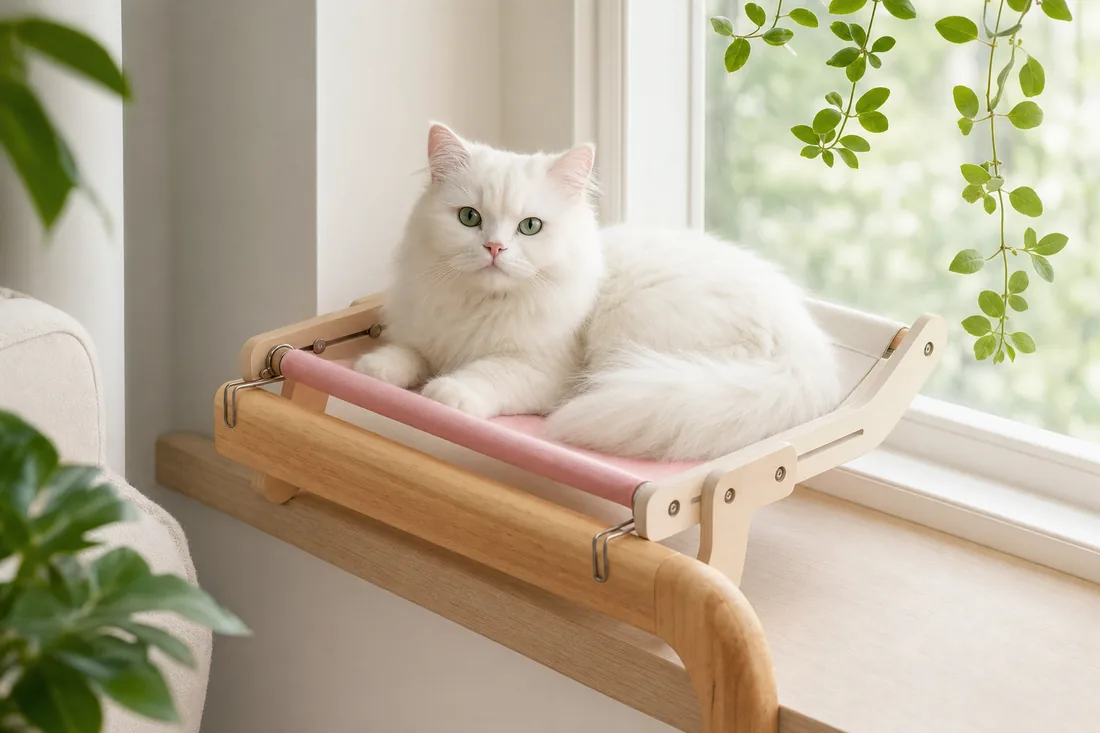
The window sill is the obvious one, but it is rarely usable as it stands: too narrow for a cat to stretch out on, cold, and often taken up by plants. A frame set on top turns it into a bed with nothing fixed to anything.
The glass itself can carry a suction-cup hammock. It is the only answer when a window has no sill at all — which is the case with a great many modern picture windows.
The radiator, often sitting right under the window, combines height with warmth. A hooked frame adds a stable seat to it.
None of the three needs a drill, which matters in a rental: all of it comes off without leaving a mark.
Where to put the post
Avoid hallways and thoroughfares: a cat does not rest where people brush past it. Prefer a window that looks onto movement — a street, a yard, a bird feeder. A blank courtyard interests nobody.
Finally, check that it can get up there without effort. An intermediate step — an armrest, a dresser, a radiator — makes all the difference, especially for an older cat.
What it changes day to day
A cat with posts of its own stops laying claim to yours. The counter, the keyboard and the back of the couch lose their appeal the moment a better spot exists elsewhere — and it is better precisely because it is higher and better oriented.

Camille Ferrand · Feline behaviorist — founder of Sunbask
Camille works with households living with one or more cats in flats. Her work turns on one question: where a cat chooses to settle, and why it ignores the bed you bought it. It was measuring dozens of window sills in clients' homes that led her to start Sunbask, and to the habit of publishing the measurements nobody else gives.
Do you still need a cat tree?
The two answer different needs. A cat tree combines a scratching post, a hiding place and height in one piece of furniture, but it takes up a permanent footprint — a real issue in a studio. A window post takes no floor space at all and gives access to the view, which a tree only offers if it is itself standing in front of a window.
In a small home the most effective combination is usually a slim vertical scratching post for claw maintenance, plus one or two window posts for rest and observation. Each does one thing, well.
The most common placement mistakes
Grouping everything in one place. Three posts side by side are not worth three spread out: a cat wants different vantage points, not a row of seats.
Installing it while the cat is out of the room. An object that appears during an absence is treated as an intrusion. Put it up in front of the cat and let it inspect the work.
Forgetting the approach. A post the cat can only reach by crossing the busiest part of the room will be ignored at exactly the hours you are home — which is precisely when it would like to be watching you.
A home that grows without building work
The arithmetic is simple: two elevated posts add two usable living areas without taking away an inch of floor. In a studio it is the only way to increase the real territory short of moving — and it is also why a well-arranged indoor cat is far less bored than people assume.
Think in routes, not isolated points
The most common mistake is to install an elevated post, watch it stay empty, and conclude that the cat does not like height. Far more often, what it does not like is the isolation of that post.
A cat does not travel from a point A on the floor to a point B four feet up: it takes a route, a series of footholds that climb and come back down. Three surfaces at 16, 32 and 48 inches are worth more than a single one at 60, even though the total height is lower.
The route also has an exit requirement: a cat will happily climb somewhere it can come down by a different way than it went up. A dead-end post — a shelf with no neighbor — gets used for two days and then abandoned. That is especially true in a multi-cat household, where being cornered up high is a position to avoid.
In practice: before adding a post, look at what already sits at mid-height around the spot you have in mind. The arm of a couch, a dresser, the top of a radiator, a storage crate are enough to make the route. You usually have nothing to buy for the intermediate step.
Renting: what can be done without drilling
The constraint is real, and it rules out wall shelves and floor-to-ceiling tension trees straight away, since both mark the surfaces they press against.
That leaves four options that mark nothing. The suction-cup hammock, which mounts on the glass itself and lifts off without residue. The clamped wooden frame, which grips the sill — no contact with the wall at all. The radiator hammock, which hangs on the fins under its own weight. And the furniture you already own, simply by clearing the top of a bookcase or a wardrobe, which costs nothing.
All four come apart in minutes and go back up somewhere else. In a home you will not stay in for ten years, that is worth as much as comfort: an arrangement that moves with the cat is one it will find intact in the next place, which matters to an animal that a change of address unsettles.
How much height, in practice?
There is no standard, but there is a useful marker: the highest post in the home should sit above the eye level of a standing adult, so around 5 ft 3 in. That is the point at which a cat stops being the one observed and becomes the observer — and it is that switch, rather than the inches, that produces the calming effect people are after.
Below it, height still helps, but mainly for warmth and for staying clear of foot traffic. Above about six and a half feet you gain little and make the climb down harder. Most of the benefit therefore sits between 4 and 6 feet, which is exactly the band a window occupies.
What feline vets say about it
pillars of a healthy feline environment — access to elevated space is one of them
— AAFP and ISFM, Journal of Feline Medicine and Surgery, 2013
the part of the day when sleep peaks
— Sterman et al. (1965), as reported by Campbell and Tobler, 1984
of sleep per 24 hours, measured by EEG in 18 cats
— Lucas and Sterman (1974), as reported by Campbell and Tobler, 1984