
· Camille Ferrand
Do cats actually like hammocks?
The question comes up before every purchase, and it turns on one distinction: it is not the hammock a cat likes, it is what the hammock lets it do.
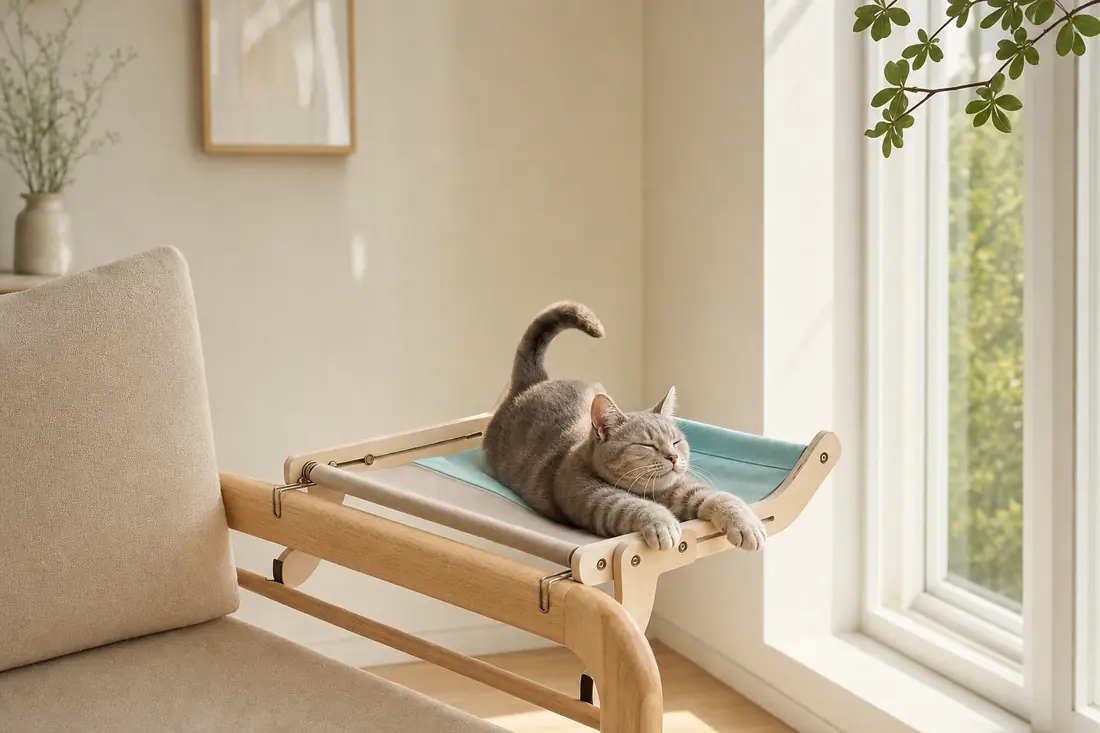
What a hammock does that nothing else does
A taut hammock takes the shape of the cat lying on it. Unlike a flat surface, the fabric dips under the weight and cups the flanks slightly — a sense of being held that many cats look for, and the same thing that explains their taste for cardboard boxes.
That shape is not a marketing invention. The Feline Environmental Needs Guidelines published by the AAFP and the ISFM in 2013 describe the ideal perch as elevated, padded, and having “a hammock-style depression to provide a sense of concealment”. The same document asks that a perch be wide and long enough “to allow the cat to stretch out fully”: the size matters as much as the dip.
The second advantage is thermal. Suspended, the bed touches neither a cold floor nor radiator metal, and air moves underneath. In summer a mesh surface stays markedly cooler than a cushion lying flat.
The four days of watching
A cat almost never adopts anything new straight away. It inspects it, comes closer, sits beside it, and eventually gets on. Give it three or four days before concluding anything.
Two things speed adoption up markedly. Putting a textile that already smells of the cat on the bed — a blanket it uses, a piece of clothing — turns a foreign object into known territory. And fitting it while the cat is in the room, rather than letting it discover something that appeared while it was away.
Why some stay empty
When a hammock is ignored, the cause is almost always the placement, rarely the product. Three mistakes come up again and again:
A window with nothing on the other side. A closed courtyard, a wall opposite: nothing to watch, so no reason to stay.
The wrong height. Too high with no stepping stone and the cat gives up — especially as it ages. Too low and the post loses its point.
A thoroughfare. A bed brushed past ten times a day is not a bed.
A stable spot, not a soft one
Stability matters more than softness. A cat tests a surface before settling on it: if it feels movement on the first press, it gives up and does not come back easily.
Which is why the mounting matters. On a suction model that means pressing the cups onto clean, degreased glass, then loading the bed by hand before letting the cat up. A rushed fitting is paid for with a lasting refusal.
Every cat, really?
Older or arthritic cats need easy access: a stepping stone is essential. Kittens adopt almost immediately, but they grow — better to choose a surface that will still be comfortable for an adult.
As for very nervous cats, they often prefer a high post set back from the glass. The hammock still makes sense, just moved a foot or so away.

Camille Ferrand · Feline behaviorist — founder of Sunbask
Camille works with households living with one or more cats in flats. Her work turns on one question: where a cat chooses to settle, and why it ignores the bed you bought it. It was measuring dozens of window sills in clients' homes that led her to start Sunbask, and to the habit of publishing the measurements nobody else gives.
Mesh or plush: what actually changes
The choice of surface is not only a matter of looks. Breathable mesh lets air through: behind a south-facing pane it avoids the oven effect a thick cushion creates. A plush face holds heat, which is an advantage in winter and a nuisance in August.
If your window gets a lot of sun, mesh is the default choice. Some models are reversible, which lets you follow the seasons without buying anything twice.
One cat or two on the same bed
Two cats that get on will happily share a wide post — several buyers describe both of theirs settled on one. Two cats that merely tolerate each other, on the other hand, will turn a single post into a point of conflict.
The rule is the same as for the rest of the territory: with more than one cat, two modest posts beat one very comfortable one. The second defuses the competition.
How long it lasts
Lifespan depends mostly on the mounting. Suction cups reseated now and then on clean glass hold for months; the same cups pressed once onto a greasy pane let go far sooner. A quick clean every two or three months keeps the original grip.
On frame models it is the canvas that wears first — which is the point of a removable, washable bed: it gets freshened rather than replaced.
Hammock or basket: what airflow changes
The difference between the two is not comfort but airflow, and it cuts both ways depending on the season.
A padded basket insulates from below. The cat sinks into it, its own heat stays trapped in the filling, and the temperature under it climbs slowly. Excellent in winter in a cool room, unpleasant in July.
A taut surface — window hammock, wooden frame, mesh — does the opposite: air moves underneath, heat dissipates, and the surface stays at room temperature. That is why so many cats abandon their basket at the first warm spell and go looking for tiles, a table, or something suspended.
Which is why offering both makes sense, or at least choosing knowingly: the plush face of the suction model answers the winter need, the mesh the summer one. It is not a styling option, it is a thermal one.
When the refusal is not about the object
A cat that ignores a hammock is rarely telling you something about the hammock. Three causes are more common than product quality:
The post is already taken. In a multi-cat home a hierarchy forms around high places, and the subordinate will not settle in full view of the dominant one. A second post, in another room, solves what looked like a hardware problem.
The spot is exposed. A cat sleeps by lowering its guard: it needs a protected back and a clear view. A post in the middle of a large pane, with nothing behind it, meets the second condition and not the first. Moving it a foot towards a corner sometimes changes everything.
The change is too recent. A move, new furniture, another animal arriving: a cat in an adjustment period does not test new objects, it consolidates what it knows. Try again three weeks later, changing nothing else.
One hammock per cat?
Not necessarily, but you need more posts than cats. The rule observed in multi-cat homes is “n + 1”: three posts for two cats, four for three. It does not come from a need for beds but from a need for choice — a subordinate cat has to be able to withdraw without negotiating.
Those posts do not have to be identical or cost the same. A cleared wardrobe top, a freed shelf and a window hammock make a perfectly workable set. What counts is the number of distinct places and how they are spread through the home, not how alike they are.
And if it adopts it a little too well?
It happens, and it surprises people: a cat that never leaves its hammock, to the point of eating there if you let it. That is not a problem in itself — it is a sign the post is answering a need that was not being met. Just make sure water stays reachable without a trip across the whole flat, and check that it still comes down for the litter tray and for play.
What feline vets say about it
pillars of a healthy feline environment — access to elevated space is one of them
— AAFP and ISFM, Journal of Feline Medicine and Surgery, 2013
of sleep per 24 hours, measured by EEG in 18 cats
— Lucas and Sterman (1974), as reported by Campbell and Tobler, 1984
of time spent asleep — 13.3 h out of 23 h recorded, in 8 cats
— Sterman et al. (1965), as reported by Campbell and Tobler, 1984